OpenAI Spends $50 Billion on Compute. We Can Save 29% — With Zero GPUs.
By Hagen Schmidt, Founder — DESTILL.ai · May 17, 2026
📖 Read Part 1: The Original Foundational Deep Dive on the $50B Compute Crisis
Why Should You Care?
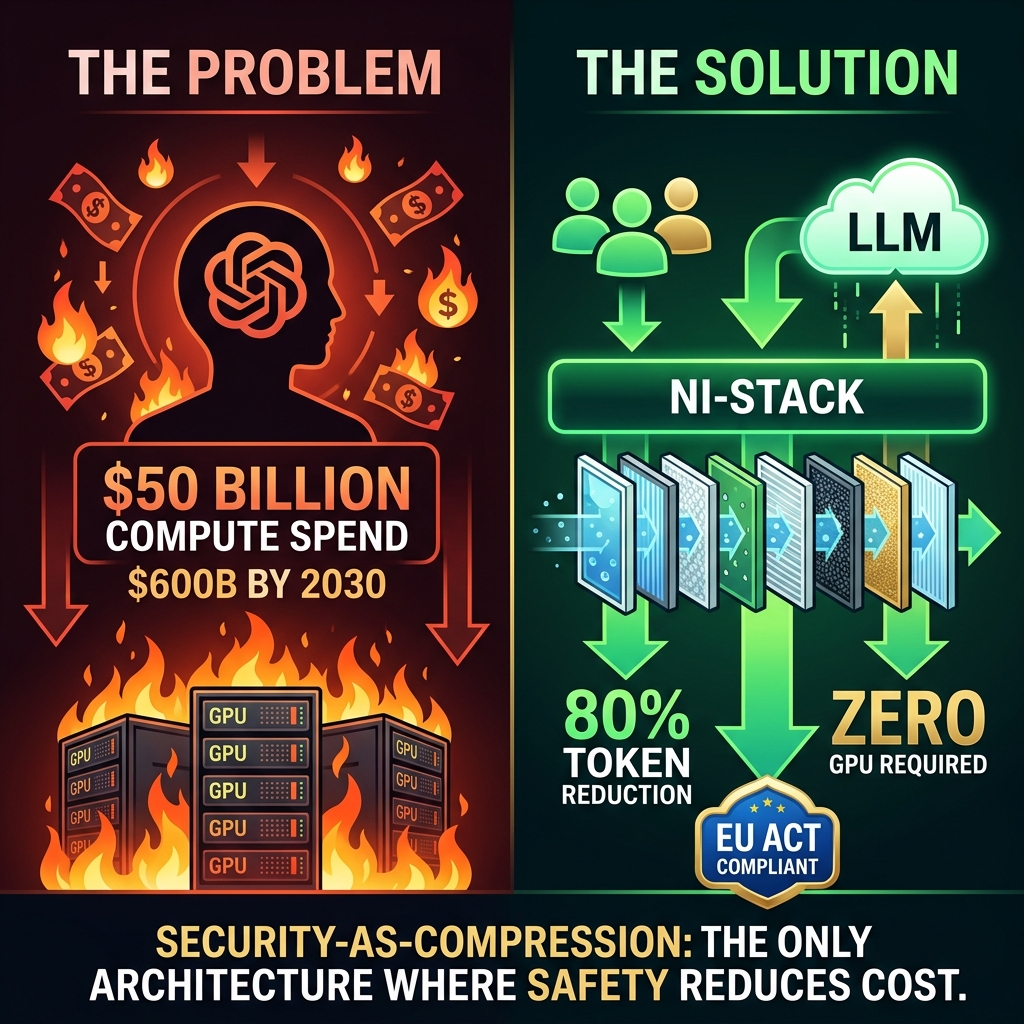
Imagine your electricity bill was $50,000 a year — and 29% of it was heating a room nobody uses. That's OpenAI right now. Except their "electricity bill" is $50 billion, and the "empty room" is GPU cycles wasted on safety classifiers that could run on a $200 CPU.
This isn't just OpenAI's problem. Every company deploying LLMs at scale — Anthropic, Google, Meta, Microsoft — faces the same structural inefficiency. And by 2030, AI compute is projected to consume the energy equivalent of 600 nuclear reactors.
The $50 Billion Problem
OpenAI President Greg Brockman testified (May 2026): $50 billion in compute spending for 2026 alone. $600 billion targeted through 2030.
- $14B projected net loss in 2026
- Sora killed (April 2026) — $15M/day too expensive to run
- 16% of total compute goes to GPU-based safety classifiers = $8B/yr burned
- Only 5-6% of users pay — the rest generate pure cost
- Profitability not expected until 2029/2030
The Compound Savings Vertical
From Guaranteed Floor to Maximum Potential
What OpenAI Has — And What They Don't
✅ They have: Prompt caching (50-90% savings on cached tokens), speculative decoding (2-3× latency reduction), KV cache quantization (INT8/FP8), MoE routing, vLLM/PagedAttention.
❌ They don't have: Output compression. Bi-directional token optimization. CPU-only safety cascades. Physics-bound compute capping. Hash-only audit trails. Fibonacci-based prompt distillation.
He's right. But destiny doesn't have to be expensive.
The Anthropic Bottleneck: Fast Growth, No Compute
OpenAI isn't the only one suffering. Anthropic is arguably the fastest-growing AI company in the world right now, but CEO Dario Amodei recently stated they are fundamentally constrained by compute. They are literally running out of data centers.
Anthropic doesn't have time to wait 2-3 years for new nuclear-powered data centers to be built. By deploying the NI-Stack as a middleware proxy, Anthropic could immediately free up 30-40% of their existing compute clusters. That is equivalent to building multiple new data centers overnight, instantly unblocking their growth trajectory without waiting on physical infrastructure.
Eight Products. One Middleware. Zero GPUs.
1. AEGIS Safety Cascade — Security as Compression
116 CPU-only agents filter 36% of traffic before GPUs fire. Replaces GPU safety classifiers consuming 16% of compute. The only architecture where safety reduces cost instead of adding to it.
Why does OpenAI need this? To run FORTRESS watermarking. Big Tech faces existential copyright lawsuits and deepfake regulation (EU AI Act). They must watermark their outputs. But watermarking costs extra compute they don't have. AEGIS provides the compute savings to pay the thermal budget, allowing them to run military-grade FORTRESS watermarking for free.
$7–18B/yr saved Claims 1–42 85% ready2. Token Budget Guard — Pre-Flight Estimation
φ-weighted math estimates output tokens BEFORE inference. Routes each request to the cheapest viable pathway.
$5–10B/yr saved Claims 321–3253. Wheeler Oracle — Context Compression
Replaces conversation history with 64-byte BLAKE3 hash pointers. 99.7% context window compression. No data loss.
$10–15B/yr saved Claims 105–1264. STENO-DRL — The Blind Spot ← OpenAI Has Nothing Like This
RL agent learns each LLM's verbosity patterns and creates a lossless shorthand dictionary. 30-60% output compression. Zero quality loss. Bi-directional. Federated dictionary learning improves across all users without sharing raw text.
$8–15B/yr saved Claims 127–1345. STENO-CoT — Embedded Reasoning Traces
Embeds chain-of-thought INTO output at φ× overhead (1.618×) instead of 2×. Compliance-as-compression for EU AI Act Art. 14.
$3–5B/yr saved Claims 135–1396. QFAI-C — Context Window Compression
Prunes RAG context BEFORE inference using φ-threshold. 30-60% prompt reduction. Tokens never enter the model — compute never happens.
$5–12B/yr saved Claims 53–627. Thermal Joule Tracker — Physics-Bound Capping
Landauer's Principle (kT·ln2) caps inference energy per request. Hard physics ceiling prevents runaway compute.
$2–5B/yr saved Claims 84–928. POAW — Compliance Without Storage
ML-DSA signed hash-only audit trails replace petabytes of inference logs.
$1–3B/yr saved Claims 201–245The SDK Roadmap: Test It Yourself
We don't ask anyone to trust a whitepaper. We're building the SDK so OpenAI, Anthropic, and any enterprise can deploy it in a sandbox and measure the savings themselves.
Phase 1: Sandbox (1,000 users)
Dockerized NI-Stack middleware. Drop in front of any OpenAI API endpoint. Time-to-Value: < 15 minutes. Just change your API Base URL. Measure token reduction, latency, and safety filtering in real-time. No model access required — pure proxy layer.
Phase 2: Scale (1M users)
Federated STENO-DRL dictionary training. Multi-tenant AEGIS cascade. Enterprise dashboard with POAW audit trail integration and EU AI Act compliance reporting.
Phase 3: Global (1B users)
Full production deployment. Hardware-accelerated Fibonacci compression on Apple NPU / AMD XDNA2. Edge-first architecture saving 600 nuclear reactors worth of energy by 2040.
The Honest Limitation
We should be transparent: STENO-DRL (our biggest blind spot product) is at 40% readiness — concept and patent stage. Wheeler Oracle is at 75%. The full compound savings of $38B/yr assume all 8 products working in concert. The conservative floor of $21B/yr uses only the products that are 80%+ production-ready today (AEGIS, Token Budget Guard, POAW, Thermal Joule Tracker).
That's why we're building the SDK — so you can start with what works today and grow into the full stack as each product matures.
The Patent Moat
3,216 unique patent claims across 11 provisional versions — Patent Pending. The moat is structured in two sovereign pillars:
🧠 NI-Stack Pillar — 2,803 Claims
Covers the complete inference optimization stack: AEGIS (498 claims, adversarial defense cascade), SIREN (217 claims, alignment monitoring), POAW (558 claims, cryptographic audit), NFI (849 claims, natural field intelligence), QFAI + Wheeler Oracle (283 claims, Fibonacci compression), NI Middleware (286 claims, hardware routing). Every layer has independent claims that stand alone — no single dependency chain collapses the entire moat.
🏰 FORTRESS Pillar — 502 Claims
Covers the complete content protection and compliance stack: FORTRESS core (415 claims, DWT watermarking, resilient + fragile seals, weight-space embedding), Deepfake Detection (87 claims, GAN artifact analysis), AdTech (12 claims, synthetic traffic validation), PII Compliance (68 claims, GDPR-native data minimization). This pillar is the compliance moat that makes Big Tech's EU AI Act exposure manageable.
🔴 The Regulatory Anti-Narrative: Fines & Deepfake Liability
Compute cost is the engineering problem. Liability is the board-level problem. The EU AI Act (Art. 50), the DSA, and deepfake regulations impose catastrophic fines (up to 7% of global revenue) for failing to identify AI-generated content or ingesting copyrighted IP without provenance.
The anti-narrative is simple: Big Tech platforms are viewed as black-box infringement machines. If you can't prove where the data came from, or mathematically distinguish human from AI, you are uninsurable and non-compliant.

The EU AI Act Mapping: Turning Regulation into a Moat
The EU AI Act is not a suggestion—it is an existential threat to hyperscalers who rely on black-box inference and unauthorized data ingestion. The NI-Stack + FORTRESS architecture is the only middleware designed to satisfy these mandates without adding computational overhead. This is why it is a must-have for Big Tech:
- Art. 14 (Human Oversight): Satisfied by AEGIS and SIREN with cryptographic trace logs for human-in-the-loop review.
- Art. 50 (Transparency & Watermarking): Satisfied by FORTRESS Resilient and Fragile Seals, enabling irrefutable distinction between human and AI content.
- Art. 10 (Data Governance): Satisfied by the NI-Stack Edge executing natively on NPUs (Zero Data Exfiltration).
- Art. 15 (Accuracy & Cybersecurity): Satisfied by the Red Team API and POAW hash-only audit trails, creating mathematically provable compliance.
🏰 The FORTRESS Pillar: Cryptographic Provenance
While the NI-Stack solves the compute and input-safety problems, FORTRESS solves the output and compliance problems. FORTRESS is a suite of military-grade steganography and post-quantum cryptographic watermarking products. It acts as the compliance engine that protects assets from AI ingestion, deepfakes, and piracy.
1. Weight-Space Watermarking (Complete Explainability)
Instead of watermarking the output tokens, we embed the watermark directly into the weight distributions of the neural network during training. It survives distillation, fine-tuning, and quantization. This provides complete explainability and provable lineage for EU AI Act compliance without exposing the weights.
Claims 3007–30092. Resilient Watermarking (IP Protection)
Survives screenshotting, compression, and aggressive cropping. Secures enterprise IP (audio, video, text, code) against unauthorized AI ingestion. Protects the copyright holder.
Claims 2701–27083. Fragile Seals (Evidence Integrity)
Shatters mathematically if a single pixel or audio frame is altered by a Deepfake GAN. Built for KYC pipelines, insurance claims, and court-admissible legal evidence.
Claims 2715–27224. Cryptographic Input Watermarking (The Ultimate Enterprise Moat)
We steganographically watermark your input prompts before they hit OpenAI. If they illegally train on your data, their next model ingests your signature into its weights — providing you with undeniable mathematical proof for litigation.
Claims 2749–2750The Ask & The Arbitrage Threat
Option A: Strategic Partnership / Licensing
We are actively building toward an enterprise licensing model and are open to strategic discussions — licensing, joint ventures, and acquisition conversations — with AI infrastructure companies and legal/compliance teams who understand the regulatory trajectory. If your organization spends >$1M/year on AI inference, the ROI math works. Contact us for an NDA-gated technical deep dive.
Option B: The Arbitrage Proxy (Available Today)
If hyperscalers don't adopt this natively, the market will route around them. Any enterprise or developer can proxy their API calls through the Destill middleware today. We compress the payload, hit the OpenAI API, and expand the result. The developer cuts their OpenAI bill by 30% instantly — without touching the model.
The Market Pressure: If developers use a compression proxy, they send fewer tokens to OpenAI. OpenAI either loses 30% of API revenue to third-party proxies — or licenses the middleware and keeps the relationship while saving $38B on their own infrastructure. The arbitrage creates the negotiating pressure.
Deploy it against 1,000 real API calls in our sandbox. Measure the savings yourself. Join the movement to save the planet from 600 unnecessary nuclear reactors.
Calculate Your Own $38B Savings
Try the interactive NI-Stack Sandbox and ROI Calculator.
Try the NI-Stack API / Calculate ROI →📧 founder@destill.ai · IP@destill.ai